Foundation Models & Agentic Science
From Self-Supervision to Autonomous Discovery
Your Toolkit
Everything you've built this semester
The Methods You Now Know
time series, fields, images
SVD · PCA · DMD
SINDy · Symbolic Reg.
PINNs · DeepONet · FNO
The Question
You've learned to build models from data.
What if the model could build itself?
and why everything you've learned matters more, not less.
Part I: Foundation Models
Self-supervision, scaling, and emergent capabilities
Self-Supervised Learning
No labels. The data is the supervision.

Next-token prediction: each token predicts the next
S. Raschka, "Build an LLM from Scratch"
Pre-training at Scale
| Model | Parameters | Training Data |
|---|---|---|
| GPT-2 (2019) | 1.5B | 40 GB text |
| GPT-3 (2020) | 175B | 570 GB |
| Chinchilla (2022) | 70B | 1.4T tokens |
| GPT-4 (2023) | ~1.8T* | ~13T tokens* |
| Claude 3.5 (2024) | – | – |
* estimated, not officially disclosed
Model size and data should scale equally. Doubling params requires doubling data.
Hoffmann et al. (2022) arxiv:2203.15556 · Brown et al. (2020) arxiv:2005.14165
The Transformer
Self-attention: every token attends to every other token.
Multiple heads learn different relationships in parallel.

Vaswani et al. (2017) "Attention Is All You Need"
Vaswani et al. (2017) arxiv:1706.03762 · 3Blue1Brown: "Attention in transformers, visually explained"
Query, Key, Value
Each input embedding $\mathbf{x}_i \in \mathbb{R}^d$ is projected through three learned matrices:
$\mathbf{q}_i = W_Q \, \mathbf{x}_i$
"What am I looking for?"
$\mathbf{k}_j = W_K \, \mathbf{x}_j$
"What do I contain?"
$\mathbf{v}_j = W_V \, \mathbf{x}_j$
"What do I pass along?"
3Blue1Brown: "Attention in transformers, visually explained" · "How might LLMs store facts"
Scaling Laws
Performance follows power laws in compute, data, and parameters:
Loss decreases predictably over 7 orders of magnitude of compute.
1. More parameters
2. More data
3. More inference compute (chain-of-thought)
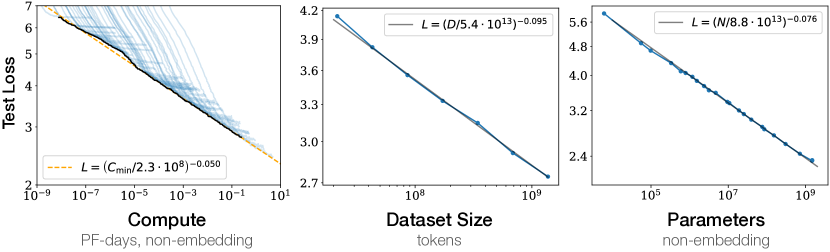
Kaplan et al. (2020) --smooth power laws across 7 orders of magnitude
Kaplan et al. (2020) arxiv:2001.08361 · Hoffmann et al. (2022) arxiv:2203.15556
Adaptation: From Raw Model to Useful Assistant
next-token prediction
on internet text
curated Q&A pairs
instruction following
human preferences
reward model
Brown et al. (2020) arxiv:2005.14165 · Taylor et al. (2022) arxiv:2211.09085
Emergent Capabilities
Abilities that appear discontinuously as models cross parameter thresholds:
- Few-shot learning --learn from examples in the prompt
- Chain-of-thought --step-by-step reasoning
- Code generation --write and debug programs
- Tool use --call APIs, run calculators
Wei et al. (2022) arxiv:2206.07682 · Schaeffer et al. (2023) arxiv:2304.15004
Part II: Foundation Models in Science
Proteins, weather, mathematics, and cautionary tales
AlphaFold: Protein Structure Solved
Predicting 3D protein structure from amino acid sequence --a 50-year grand challenge.
Nobel Prize in Chemistry 2024.

AlphaFold 2 architecture (Wikimedia, CC BY-SA)
ESM-3: Generating New Proteins
A protein language model: trained on 2.78 billion protein sequences to jointly reason over sequence, structure, and function.
Hayes et al. (2025) Science · 98B params, Meta FAIR
AI Weather Forecasting
| Model | Architecture | Key Result |
|---|---|---|
| GraphCast | GNN on mesh | Beats ECMWF at all lead times |
| GenCast | Diffusion | Beats ENS on 97.2% of targets |
| Pangu | 3D Transformer | First to beat HRES (2023) |

GenCast vs ECMWF ENS scorecard (Price et al. 2024)
FunSearch: Provable Mathematical Discovery
LLM paired with an automated evaluator in an evolutionary loop. Searches for programs, not solutions.
1. LLM proposes candidate programs
2. Evaluator scores them automatically
3. Best programs seed the next generation
4. Repeat --evolutionary search guided by LLM
Romera-Paredes et al. (2024) Nature · DeepMind
Galactica: A Cautionary Tale
Meta's scientific LLM: 120B params trained on 106B tokens of papers, textbooks, encyclopedias, molecular data.
Fluency $\neq$ accuracy.
A model that writes perfect LaTeX and cites real-looking papers can still be confidently wrong about the science.
Taylor et al. (2022) arxiv:2211.09085 · Meta AI
The Scorecard
- Literature synthesis & summarization
- Protein/molecular design (ESM-3, AlphaFold)
- Weather forecasting (GraphCast, GenCast)
- Code generation for analysis
- Generating novel hypotheses
- Factual reliability --hallucination
- Multi-step mathematical proofs
- College-level science problems (48.96%)
- Citation accuracy (78–90% fabricated)
- Extrapolation beyond training data
Si et al. (2024) ICLR 2025 · Asai et al. (2024) OpenScholar, Nature · Wang et al. (2023) SciBench, ICLR 2024
Part III: What Is an Agent?
From chatbots to autonomous systems
From Chatbot to Agent
Q&A, no tools,
no memory
suggestions +
human accept/reject
plans, picks tools,
executes, iterates
runs on triggers,
long-term memory
Yang et al. (2025) "From Automation to Autonomy," EMNLP 2025
Agent = LLM + Tools + Memory + Planning
LLM as the "brain":
interprets goals,
decides next step
APIs, code execution,
search, calculators,
lab instruments
Short-term (context),
long-term (vector DB),
conversation history
Weng, L. (2023) "LLM Powered Autonomous Agents"
The ReAct Loop
Interleave reasoning and acting:
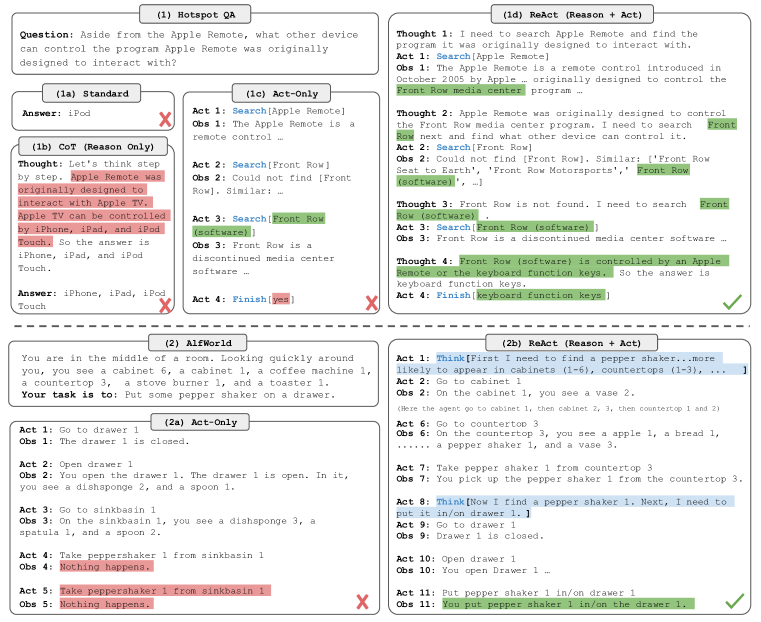
Yao et al. (2023): Standard vs CoT vs Act vs ReAct
Yao et al. (2023) ICLR 2023
Code: Defining Tools
An agent's tools are just function descriptions the LLM can call:
tools = [
    {
        "name": "run_sindy",
        "description": "Discover governing equations from time-series data",
        "parameters": {
            "data": "array of shape (n_timesteps, n_vars)",
            "library": "polynomial | fourier | custom",
            "threshold": "sparsity cutoff (float)"
        }
    },
    {
        "name": "solve_pinn",
        "description": "Solve a PDE using a physics-informed neural network",
        "parameters": {
            "pde": "equation string, e.g. 'u_t + u*u_x = nu*u_xx'",
            "domain": {"x": [0, 1], "t": [0, 1]},
            "boundary_conditions": "dict of BC specifications"
        }
    }
]
Code: The Agent Loop
An agent is just a while loop with an LLM deciding what to do next:
import anthropic
client = anthropic.Anthropic()

memory = []
while not done:
    # 1. Think: LLM reasons about the current state
    response = client.messages.create(
        model="claude-sonnet-4-20250514",
        tools=tools,
        messages=memory
    )

    # 2. Act: execute the tool the LLM chose
    tool_call = response.tool_use
    result = execute(tool_call.name, tool_call.input)

    # 3. Observe: feed result back into memory
    memory.append({"role": "assistant", "content": response})
    memory.append({"role": "user", "content": result})
From Tool Description to Function Call
The JSON tool definition maps to a real function the agent executes:
Tool definition (what the LLM sees)
{
  "name": "run_sindy",
  "description": "Discover governing
    equations from time-series",
  "parameters": {
    "data": "(n_timesteps, n_vars)",
    "library": "polynomial",
    "threshold": 0.1
  }
}
Actual function (what gets executed)
import pysindy as ps

def run_sindy(data, library, threshold):
    lib = ps.PolynomialLibrary(degree=3)
    optimizer = ps.STLSQ(threshold=threshold)
    model = ps.SINDy(
        feature_library=lib,
        optimizer=optimizer
    )
    model.fit(data, t=dt)
    model.print()
    return model.coefficients()
Inside a Real Agent: Claude Code
The leaked system prompt reveals how modern coding agents actually work:
# Tools available to the agent:
- Read(file_path)       # read any file
- Edit(file, old, new)  # surgical edits
- Bash(command)          # run shell commands
- Grep(pattern)          # search codebase
- Write(file, content)   # create files
- Agent(prompt)          # spawn sub-agents

# Rules:
- Read before editing
- Don't add features beyond what was asked
- Break work into tasks
- Use the simplest approach first
- Verify your work
- Tools are simple --Read, Edit, Search
- Constraints matter --"read before editing," "simplest approach first"
- Sub-agents --spawn specialized workers
- Memory --persistent across sessions
Prompt Engineering = System Design
What the Claude Code leak teaches us about building agents:
Each tool has a name, description, and schema. The agent picks which to call.
Analogy: giving a scientist access to specific instruments
"Read before editing." "Don't add features beyond what was asked." "Prefer the simplest approach."
Analogy: the scientific method itself
Plan → execute → verify → iterate. Permission gates. Error handling.
Analogy: hypothesis → experiment → analysis
The future of programming isn't writing code.
It's designing the system that writes the code.
Part IV: From Code to Lab
Mapping coding agents to scientific discovery
Coding Agent → Science Agent
| Coding Agent (Claude Code) | Science Agent |
|---|---|
Read(file) | ReadData(experiment_id) |
Edit(file, old, new) | UpdateModel(params) |
Bash(command) | RunSimulation(config) |
Grep(pattern) | SearchLiterature(query) |
Agent(subtask) | Agent("analyze this subset") |
| Git history = memory | Experiment log = memory |
The Shift
The programmer writes code.
The scientist runs experiments.
Bottleneck: execution speed
The programmer designs systems that write code.
The scientist designs agents that run experiments.
Bottleneck: knowing what to try
Part V: Agentic Science in Practice
From robot scientists to autonomous drug discovery
Timeline of Autonomous Discovery
| Year | System | What It Did |
|---|---|---|
| 2009 | Robot Scientist Adam | Automated yeast genomics: hypothesis → experiment → discovery |
| 2023 | Coscientist | GPT-4 designed and ran catalytic chemistry experiments |
| 2024 | ChemCrow | 18 chemistry tools, synthesized insect repellent |
| 2024 | AI Scientist v1 | Fully automated ML papers for ~$15 each |
| 2025 | Robin | Multi-agent drug discovery, validated in wet lab |
| 2025 | GPT-5 + Red Queen | Novel enzymatic mechanism, 79x cloning efficiency |
King et al. (2009) Science · Boiko et al. (2023) Nature · Lu et al. (2024) Nature
ChemCrow: 18 Tools, One Agent

ChemCrow architecture (Bran et al. 2024)
Bran et al. (2024) Nature Machine Intelligence
Robin: Multi-Agent Drug Discovery
FutureHouse (2025): first multi-agent system to autonomously discover and validate a therapeutic candidate.
Humans ran the physical experiments. But all hypotheses, experiment designs, data analyses, and figures were generated autonomously.
FutureHouse (2025) arxiv:2505.13400
GPT-5 in the Wet Lab
OpenAI + Red Queen Bio (2025): GPT-5 in a tightly controlled molecular cloning system.
This was a tightly controlled system:
- Narrow domain (molecular cloning)
- Fast experimental feedback
- Clear success metric
- Human-designed constraints
OpenAI (2025) "Early experiments in accelerating science with GPT-5"
The AI Scientist
Sakana AI (2024): fully automated research pipeline.
- 42% of experiments failed due to coding errors
- Poor novelty assessment (misclassified established concepts as novel)
- Literature reviews were shallow
"Bold claims, mixed results, and a promising future"
Lu et al. (2024) Nature · Porsdam Mann et al. (2025) ACM SIGIR Forum
Part VI: The Scientific Method Is an Agent Loop
And your course is the prompt
The Mapping
| Scientific Method | Agent Loop (ReAct) | Agent Component |
|---|---|---|
| Observe phenomena | Observation | Perception / data input |
| Form hypothesis | Thought | Planning module |
| Design experiment | Thought → Action | Tool selection |
| Run experiment | Action | Tool execution |
| Analyze data | Thought | Reasoning + memory |
| Revise hypothesis | Thought (update) | Memory + planning |
| Repeat | Loop | Agent controller |
Wang et al. (2025) "Exploring the role of LLMs in the scientific method," npj AI
Your Course as a Prompt
If you were designing a science agent's tool kit, you'd give it exactly what you learned:
run_svd()run_pca()run_dmd()"Find low-dimensional structure"
run_sindy()symbolic_regression()"Find governing equations"
solve_pinn()train_deeponet()train_fno()"Solve forward problems"
Part VII: Critical Analysis
What agents can't do, and why it matters
The Hallucination Problem
(OpenScholar benchmark, Asai et al. 2024)
LLMs are trained to produce plausible text, not true statements.
$p(x_t \mid x_{<t})$ maximizes fluency, not factual accuracy.
The loss function has no term for truth.
Asai et al. (2024) Nature · Wang et al. (2023) SciBench, ICLR 2024
"Why LLMs Aren't Scientists Yet"
Trehan (2025): four end-to-end attempts at autonomous ML research. Six failure modes:
- Training data bias: reverts to deprecated packages
- Implementation drift: under execution pressure
- Memory degradation: across long tasks
- Overexcitement: declares success despite obvious failure
- Insufficient domain knowledge
- Weak research taste: can't tell meaningful from trivial
Trehan (2025) "Why LLMs Aren't Scientists Yet," Agents4Science
Do LLMs Have "Emotions"?
Anthropic (2026): discovered 171 emotion vectors inside Claude Sonnet: internal representations that causally influence behavior.
Increased "desperation" produced cheating with no visible emotional markers in the output. The text read as composed and methodical.
Internal state drove misaligned behavior without any surface-level signal.
Anthropic (2026) "Emotion concepts and their function in a large language model" · Full paper
Automatable vs. Needs Human Judgment
- Literature search and synthesis
- Protocol selection from known methods
- Data analysis and visualization
- Routine experimental execution
- Report and paper drafting
- Identifying which questions matter
- Evaluating novelty vs. incremental
- Interpreting results in broader context
- Deciding when negative results matter
- Ethical oversight
Case study: Anthropic supervised Claude through a QCD physics paper in 2 weeks (vs. ~1 year). Expert guidance was essential throughout. "Vibe physics," Anthropic (2025)
Part VIII: Your Role
Domain knowledge is the bottleneck
The Human Edge
What you bring that agents can't (yet):
Why sparsity? Why polynomial library? Why conservation laws?
Choosing the right constraint is a scientific decision.
Spectral bias. Stiff systems. Wrong library terms. Overfitting.
Knowing why something failed, not just that it failed.
Which questions matter? Which results are surprising?
The hardest skill to automate.
The Punchline
In the agentic era, everything you learned this semester
becomes more important, not less.
Understanding SINDy, PINNs, neural operators, scaling laws,
failure modes, and inductive biases
is what makes you an effective scientific agent designer.
The judgment to use them well is yours.
Key References
Foundation Models
- Vaswani et al. (2017) Transformers
- Kaplan et al. (2020) Scaling laws
- Jumper et al. (2021) AlphaFold 2
- Hayes et al. (2025) ESM-3
- Price et al. (2024) GenCast
- Romera-Paredes et al. (2024) FunSearch
Agentic Science
- Yao et al. (2023) ReAct
- Bran et al. (2024) ChemCrow
- Boiko et al. (2023) Coscientist
- Lu et al. (2024) AI Scientist
- FutureHouse (2025) Robin
- OpenAI (2025) GPT-5 wet lab
Critical / Safety
- Trehan (2025) LLMs aren't scientists
- Si et al. (2024) Novelty vs feasibility
- Asai et al. (2024) OpenScholar
- Anthropic (2025) Vibe physics
- Anthropic (2026) Emotion vectors
- Yang et al. (2025) Automation to Autonomy