Music Intelligence Lab · AUB
The Rope
a musical instrument
Rope flow: traditionally a form of exercise. We decided to make it sing.
The general problem
The sound comes back through your own ears,
and changes the movement that made it.
The instrument we already trust
Hundreds of years of design, and hundreds of years of hands learning it.
Every problem you were trained on
had a unique answer.
This one has none.
No metric for success.
Any movement could map to any sound.
No supervision. No right or wrong. A matter of taste.
A lesson in modeling
Do the legs matter? Decide. They go.
The rope: a chain of links. Simpler: a rod.
And now you can compute
\( F_{\text{centrifugal}} \propto \omega^2 \)
Swing twice as fast, feel four times the pull.
What the rope tells us
two wrists · six channels each · one hundred times a second
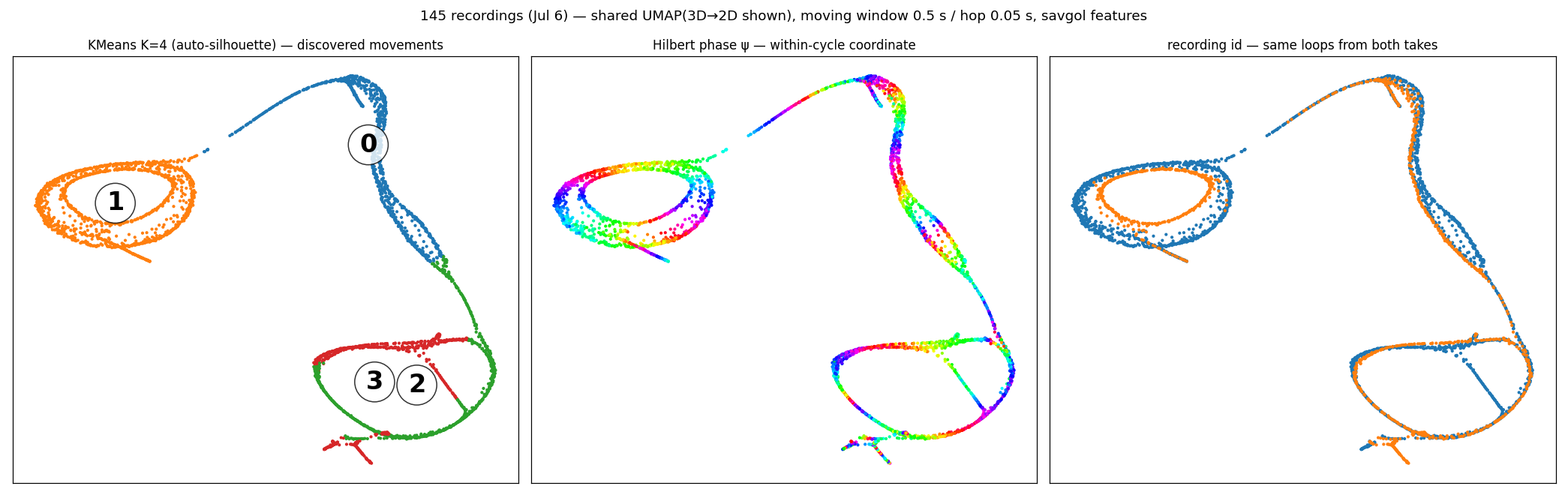
A real recording: the dragon roll, reconstructed from two wrist sensors.
Twelve channels. Two takes. No labels.
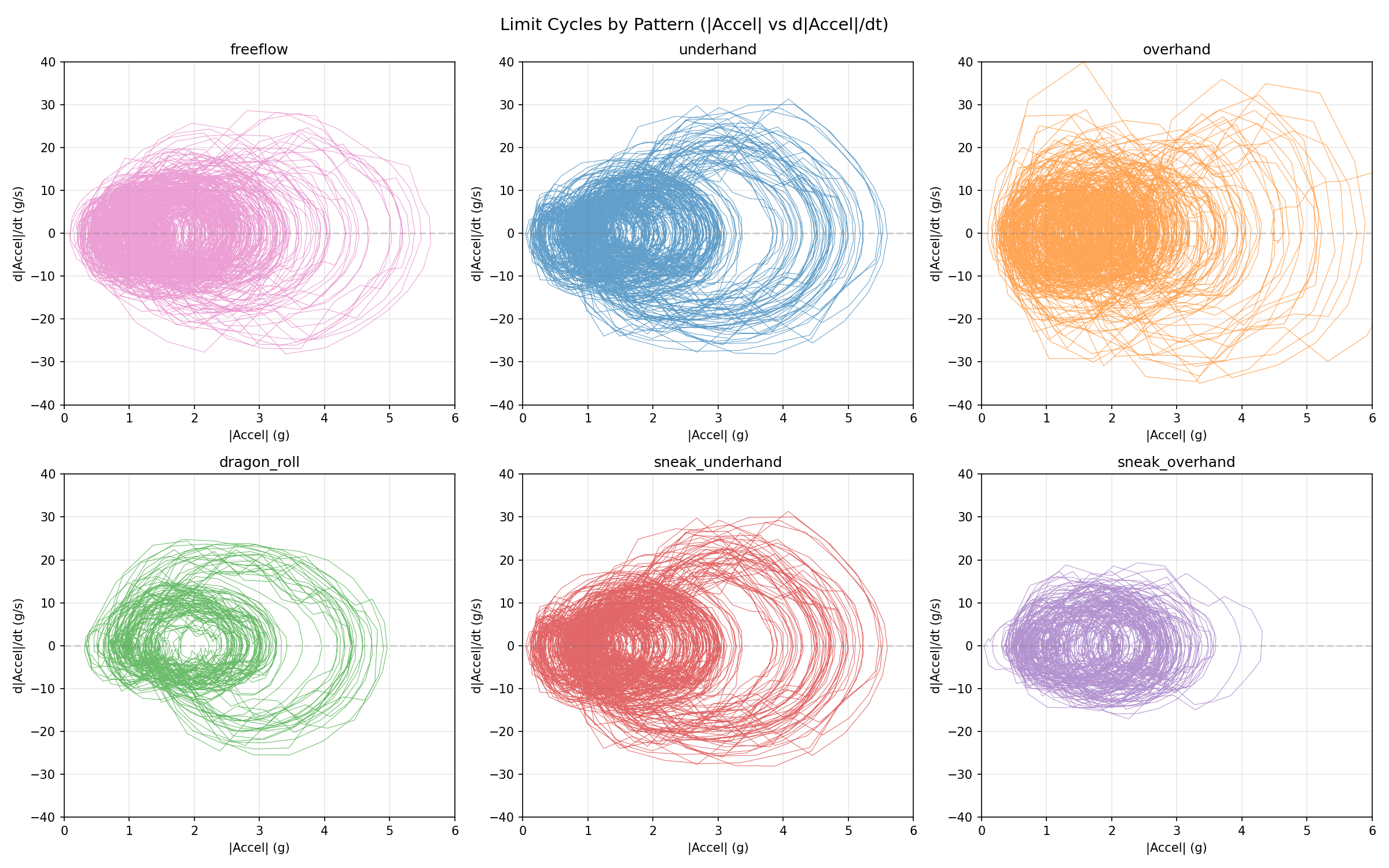
Three loops, an idle, and a phase going around each.
It even found the choreography
Eleven transitions each way. Zero off-pattern.
About a dozen primitives.
The size of a diatonic chord set.
The swing becomes a point on a loop.
The loop becomes the score.
One motion. Many voices.
Pachelbel's canon,
played by a rope.
Three virtual strings, driven live by the swing.
There is no right answer here.
There is only sound that comes back
and changes you.
An instrument is a model
of what it means to move musically.
We are still tuning it.
Music Intelligence Lab · come play